Your expert in facade insulation with rendering
Isoleaz assists you with the insulation of your facade with plaster in Luxembourg
Isoleaz assists you with the insulation of your facade with plaster in Luxembourg
Home » Facade insulation with plaster
EXCELLENTTrustindex vérifie que la source originale de l'avis est Google. Je suis très satisfaite du bon travail effectué. Très Ravi deu résultats.je le recommande vivement. Merci a vousPublié sur GoogleTrustindex vérifie que la source originale de l'avis est Google. Entreprise très professionnelle, suivi très rapide à la demande de devis. Des professionnels très compétents, aimables et disponibles à répondre à toutes mes questions et proposer des solutions. À recommander !Publié sur GoogleTrustindex vérifie que la source originale de l'avis est Google. Entreprise très sérieuse qui a refait l'isolation et le ravalement de notre façade. Qualité au top et rapidité d'exécution remarquable. Quelques soucis de communication au début qui ont rapidement été réglés. Je tiens également à souligner le professionnalisme et la disponibilité d'Alex.Publié sur GoogleTrustindex vérifie que la source originale de l'avis est Google. tres satisfait du résultat et de l'équipe. Du très bon travailPublié sur GoogleTrustindex vérifie que la source originale de l'avis est Google. Très satisfait du résultat merci à Alex pour la qualité de son travail et sa sympathie. Je recommande à 100%Publié sur GoogleTrustindex vérifie que la source originale de l'avis est Google. Entreprise dynamique, équipe motivée et professionnelle. Travail réalisé dans les délais convenus (en tenant compte qu'ils ne gèrent pas encore la météo). Isoleaz s'occupe tout, je recommande!Publié sur GoogleTrustindex vérifie que la source originale de l'avis est Google. Ouvriers très soigneux pour l'isolation du plafond de mes caves. Le travail était pourtant délicat en raison des nombreux tuyaux, chemins de câbles et autres fixés au plafond. Travail très professionnel.Publié sur GoogleTrustindex vérifie que la source originale de l'avis est Google. Merci à ISOLEAZ. Les travaux d'isolation des pignons de notre maison ont été parfaitement réalisés. Travail propre et soigné. Nous sommes très satisfaits.Publié sur GoogleTrustindex vérifie que la source originale de l'avis est Google. Société à recommander : Sylvain, le délégué commercial, n'a pas hésité à revenir chez moi pour répondre à mes questions. Les ouvriers ont très bien travaillé, très méticuleux, et très rapides. Et à propos du chef de chantier, Vincent, il est aussi très "pro". Et tout ça mérite les 5 étoiles :)Publié sur GoogleTrustindex vérifie que la source originale de l'avis est Google. Je suis vraiment ravi du travail effectué par les équipes Isolaez chez moi. Ils ont réalisé l'ensemble de l'isolation de la maison, et je n'ai eu aucun commentaire a faire étant donné le professionnalisme dont ils ont fait preuve, ce qui n'est pas commun.
At Isoleaz, we leverage our expertise to serve your facade insulation project with rendering in Luxembourg. Our ambition is simple: to sustainably improve the thermal and acoustic comfort of your home, while ensuring the visual appeal of your facade. Thanks to qualified professionals, expert equipment, and meticulous attention to detail, we guarantee results that meet your exact requirements, from the initial assessment to the finishing touches.
Are you looking to limit heat loss, improve well-being in your interior and restore the appearance of your facade? Facade insulation with plaster meets precisely these three needs. The principle consists of applying a finishing coating loaded with insulating components directly to the exterior walls, after installation of a rigid insulating layer. This method effectively eliminates thermal bridges, reinforces the energy performance of the building and protects the facade from climatic hazards.
In Luxembourg, where many homes date from before the 1990s and have significant thermal deficiencies, this technique is particularly relevant for owners who wish to progress in their energy performance certificate (EPC) without undertaking work of disproportionate complexity.
The plaster used in this type of insulation falls into two main categories, each with distinct properties:
Mineral plaster is a vapor-permeable coating. It allows walls to breathe freely, regulates ambient humidity levels, and helps eliminate thermal bridges. Its mineral composition makes it particularly suitable for new or existing walls, offering remarkable durability.
Synthetic plaster is more flexible than its mineral counterpart. This flexibility significantly reduces the appearance of cracks over time, a considerable advantage in areas subject to large temperature fluctuations. Supplied as a homogeneous paste, it remains vapor-permeable while repelling deposits and allowing rainwater to run off without penetrating the wall.

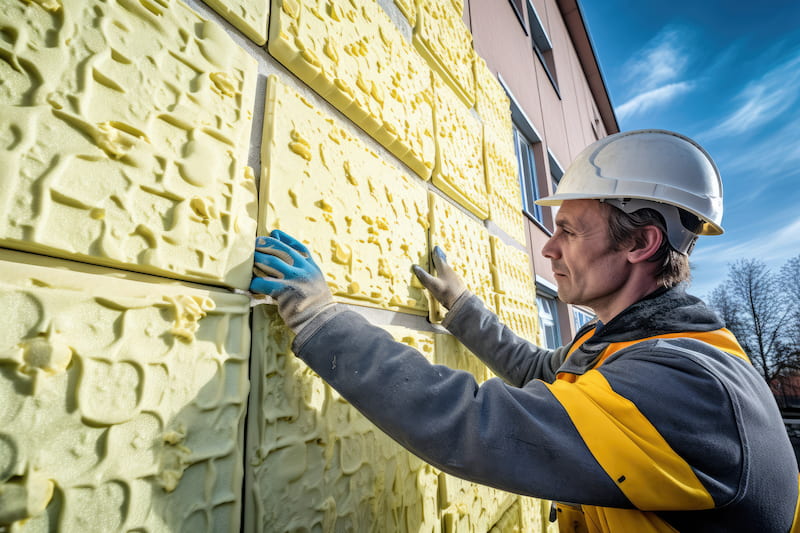
Applying plaster over insulation is a technically demanding operation, requiring precise expertise and appropriate professional equipment. It is organized into three successive phases:
The plaster is applied in a thin layer, just a few millimeters thick, directly onto the insulated exterior wall. The most frequently used substrate is expanded polystyrene board, which provides a smooth surface that promotes adhesion and reduces the risk of cracking. Polyurethane and rock wool can also be used as substrates, depending on the site constraints and the desired thermal performance. Rigid panels are generally preferred to flexible substrates because they guarantee a more uniform and aesthetically pleasing result.

Ask our team of experts for advice
Render plays a fundamental protective role for your facade. Its composition makes it impermeable to liquid water, preventing infiltration that could damage the insulation or load-bearing walls. However, it remains permeable to water vapor, allowing the facade to function as a breathable membrane and preventing condensation within the walls. This dual behavior directly contributes to the longevity of the insulation system and the overall health of the building.
One of the key advantages of rendering over insulation lies in the diversity of finishes available. Depending on the product chosen and the application method, a wide variety of textures can be achieved: smooth, scraped, crushed, or sprayed. The range of available colors is also very extensive, offering complete customization of the building’s exterior appearance. By unifying the facade surface, rendering gives it a neat and cohesive look, while also modernizing the building’s appearance.
Compared to other exterior cladding techniques, applying stucco is relatively quick, especially when done by mechanical spraying. Trowel application, while slower, allows for finer control of the finish. In both cases, the thin layer reduces the amount of material needed, which helps keep the overall cost down.
A rendered facade requires no special maintenance. Regular cleaning with soapy water or a slightly diluted solution is generally sufficient to preserve its appearance over time. For larger surfaces or stubborn dirt, a pressure washer set to a moderate pressure will achieve a spotless result without damaging the render. Natural preparations made with white vinegar, coarse salt, and water can also be used for maintenance that is gentle on materials and the environment.
Ask our team of experts for advice
Among the available solutions for improving a building's thermal performance, facade insulation with rendering stands out for its particularly attractive price-performance ratio. In Luxembourg, the average cost is between €130 and €160 per square meter, excluding VAT and labor. This is one of the most competitive approaches for treating the exterior walls of a building while achieving a refined aesthetic result.
Several factors influence the final amount:
Every construction project has its own unique characteristics, and only a thorough site inspection can provide a reliable estimate. At Isoleaz, you'll receive your personalized quote in less than 24 hours, with no obligation on your part.
Facade insulation work with rendering can benefit from several aid schemes implemented by the Luxembourg authorities to support the energy renovation of residential buildings. In 2026, these mechanisms are particularly advantageous and can cover a significant portion of the budget involved:
Administered by the Klima-Agence, this subsidy can cover up to 62.5% of the cost of renovations for homes over ten years old. The current system provides fixed amounts defined in euros per square meter, with an additional subsidy for bio-based insulation materials.
Aid subject to specific energy performance criteria, available to owners of residential properties wishing to improve their thermal envelope.
This rate applies to all renovation work on a dwelling over ten years old used as a main residence, compared to an ordinary rate of 17% in the Grand Duchy.
Some municipalities offer additional financial support, the amounts and conditions of which vary depending on the locality concerned.
To find out the eligibility requirements specific to your situation, the Klima-Agence and the myenergy portal remain the essential resources in Luxembourg. The Isoleaz team will assist you in preparing your grant application, ensuring that each required document is correctly completed to maximize the financial assistance you are entitled to.
Discover in detail all the grants and subsidies available for your insulation work.
Discover the available bonusesAsk our team of experts for advice
Facade insulation with rendering is a precision job that requires much more than basic know-how. From preparing the surfaces and choosing the insulation system to applying the finishing coat, each phase demands rigorous technical expertise and real-world experience. The Isoleaz teams combine these skills and stay informed of regulatory and technical developments specific to the Luxembourg market.
Our presence in the Grand Duchy and the Greater Region has allowed us to develop a deep understanding of local realities: building types, specific climatic constraints, and the applicable regulatory framework. Far from offering standardized solutions, we analyze each project individually to provide you with the solution truly tailored to your property.


At Isoleaz, customer satisfaction is the measure of every project. Your project is managed methodically, respecting agreed deadlines and ensuring a smooth execution without unforeseen issues. From surface preparation to the final plastering, each step receives equal attention. We believe a well-insulated facade should be as visually appealing as it is thermally efficient.
Our relationship with you doesn’t end on the day the work is completed. We remain available to answer your questions and respond quickly if needed, because a successful project is also measured over time.