Your expert in cavity wall insulation
Isoleaz assists you with the insulation of your cavity walls in Luxembourg
Isoleaz assists you with the insulation of your cavity walls in Luxembourg
Home » Cavity Wall Insulation
Our experts will assist you in obtaining grants for the insulation of your home.
We provide personalized support for each project before, during and after the work.
Collaborating with Isoleaz guarantees quality work by certified experts.
EXCELLENTTrustindex vérifie que la source originale de l'avis est Google. Je suis très satisfaite du bon travail effectué. Très Ravi deu résultats.je le recommande vivement. Merci a vousPublié sur GoogleTrustindex vérifie que la source originale de l'avis est Google. Entreprise très professionnelle, suivi très rapide à la demande de devis. Des professionnels très compétents, aimables et disponibles à répondre à toutes mes questions et proposer des solutions. À recommander !Publié sur GoogleTrustindex vérifie que la source originale de l'avis est Google. Entreprise très sérieuse qui a refait l'isolation et le ravalement de notre façade. Qualité au top et rapidité d'exécution remarquable. Quelques soucis de communication au début qui ont rapidement été réglés. Je tiens également à souligner le professionnalisme et la disponibilité d'Alex.Publié sur GoogleTrustindex vérifie que la source originale de l'avis est Google. tres satisfait du résultat et de l'équipe. Du très bon travailPublié sur GoogleTrustindex vérifie que la source originale de l'avis est Google. Très satisfait du résultat merci à Alex pour la qualité de son travail et sa sympathie. Je recommande à 100%Publié sur GoogleTrustindex vérifie que la source originale de l'avis est Google. Entreprise dynamique, équipe motivée et professionnelle. Travail réalisé dans les délais convenus (en tenant compte qu'ils ne gèrent pas encore la météo). Isoleaz s'occupe tout, je recommande!Publié sur GoogleTrustindex vérifie que la source originale de l'avis est Google. Ouvriers très soigneux pour l'isolation du plafond de mes caves. Le travail était pourtant délicat en raison des nombreux tuyaux, chemins de câbles et autres fixés au plafond. Travail très professionnel.Publié sur GoogleTrustindex vérifie que la source originale de l'avis est Google. Merci à ISOLEAZ. Les travaux d'isolation des pignons de notre maison ont été parfaitement réalisés. Travail propre et soigné. Nous sommes très satisfaits.Publié sur GoogleTrustindex vérifie que la source originale de l'avis est Google. Société à recommander : Sylvain, le délégué commercial, n'a pas hésité à revenir chez moi pour répondre à mes questions. Les ouvriers ont très bien travaillé, très méticuleux, et très rapides. Et à propos du chef de chantier, Vincent, il est aussi très "pro". Et tout ça mérite les 5 étoiles :)Publié sur GoogleTrustindex vérifie que la source originale de l'avis est Google. Je suis vraiment ravi du travail effectué par les équipes Isolaez chez moi. Ils ont réalisé l'ensemble de l'isolation de la maison, et je n'ai eu aucun commentaire a faire étant donné le professionnalisme dont ils ont fait preuve, ce qui n'est pas commun.
At Isoleaz, we handle all cavity wall insulation projects in Luxembourg. Our team carefully analyzes each situation to guide you towards the most suitable solution for your home, and supports you from the initial site visit to the completion of the project.
Many Luxembourg homes built before the 1980s feature double-walled construction, separated by an air gap known as a cavity wall. This configuration, very common in post-war buildings up until the 1970s, actually presents an interesting opportunity: this empty space can be filled with high-performance insulation without undertaking major renovations or altering the building’s exterior appearance.
Before proceeding, three questions should be considered:
At Isoleaz, we take the time to analyze your situation in detail before making any recommendations. Our goal is to offer you the most effective solution, achievable under the best conditions and sustainable over time.
Cavity wall insulation involves injecting insulating material into the space between the two walls to eliminate heat exchange. This technique helps retain heat inside the home in winter and limits the penetration of outside heat in summer, resulting in significantly improved thermal comfort and lower energy bills.
The implementation method varies depending on the project.
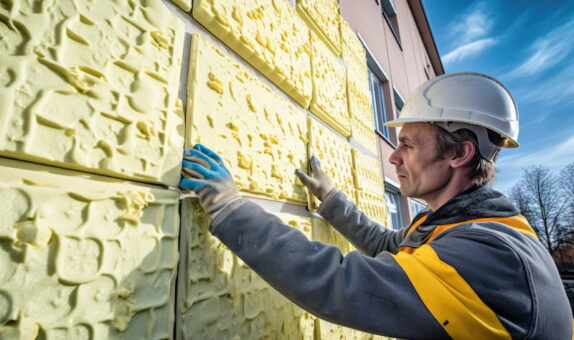
During a renovation, the injection is generally carried out from the outside. Small holes are drilled in the mortar joints of the facade, through which the insulation is injected under pressure until the cavity is evenly filled. Once the operation is complete, these holes are carefully sealed with a material that matches the color of the existing mortar joints, for a virtually invisible result. This type of work can often be completed in a single day, with minimal disruption to the occupants.
In new construction, the double wall is insulated during the structural phase. The insulating material is placed against the inner wall before the finishing coating is applied, whether it is plaster, wood cladding or other facing.

Identifying the presence of cavity walls is not always easy. However, a few clues can guide the diagnosis:
The only way to be certain is to call on a qualified professional, who will carry out a thorough check before any decision is made.
The presence of cavity walls is not enough to guarantee the feasibility of insulation. Several criteria must be checked before starting the work:
This must be ensured by a vapor-permeable facade coating. Walls regularly exposed to rainfall absorb more moisture and dry more slowly, which can eventually lead to significant problems.
At Isoleaz, our team systematically conducts a thorough assessment before confirming the project’s feasibility, guaranteeing you an efficient and trouble-free construction process.

Cavity wall insulation offers several advantages that make it one of the most sought-after solutions for Luxembourg homeowners wishing to improve their housing without invasive work.
After the roof, walls are one of the main sources of heat loss in a building. Effectively treating this area can lead to energy savings of up to 25% on heating bills, a particularly significant gain in the current context of rising energy prices.
Other notable advantages:
Cavity wall insulation does, however, have one major limitation to be aware of: the risk of moisture accumulation in the cavity after the insulation is installed. This phenomenon, although infrequent when the site is properly prepared, can lead to long-term problems if it is not anticipated. Solutions exist to address this, such as the injection of suitable waterproofing gels. This is precisely why a preliminary inspection of the walls is an essential step before any work begins..
Ask our team of experts for advice
The choice of insulation directly determines the system’s performance and its long-term behavior. For cavity wall insulation, specific materials are used, as they must be able to be blown or injected into a confined space without losing their properties.
Blown-in fiberglass insulation is one of the most commonly used solutions for this type of project. Lightweight and efficient, it is evenly distributed throughout the cavity using a blowing machine, ensuring complete coverage with no gaps. It offers good thermal and acoustic performance, and has good fire resistance.
Other materials can also be used depending on the site configuration: injected polyurethane foam, particularly well-suited to narrow cavities thanks to its controlled expansion, or polystyrene beads, which are lightweight and moisture-resistant.
Our Isoleaz advisors will guide you toward the material best suited to your home, taking into account the cavity thickness, the building’s orientation, and your energy performance goals.
The cost of cavity wall insulation depends primarily on the total surface area to be treated and the chosen material. It is generally the least expensive wall insulation method, particularly because it requires neither extensive scaffolding nor demolition or reconstruction work.
As a guide, the average price is between €130 and €160 excluding VAT per square meter, all services included. This amount may vary depending on the specific characteristics of the project and the accessibility of the walls.
At Isoleaz, we provide you with a personalized and detailed quote within a maximum of 24 hours, so you have a clear understanding of the budget before making any commitment.
Discover in detail all the grants and subsidies available for your insulation work in Luxembourg.
Discover the available bonusesAsk our team of experts for advice